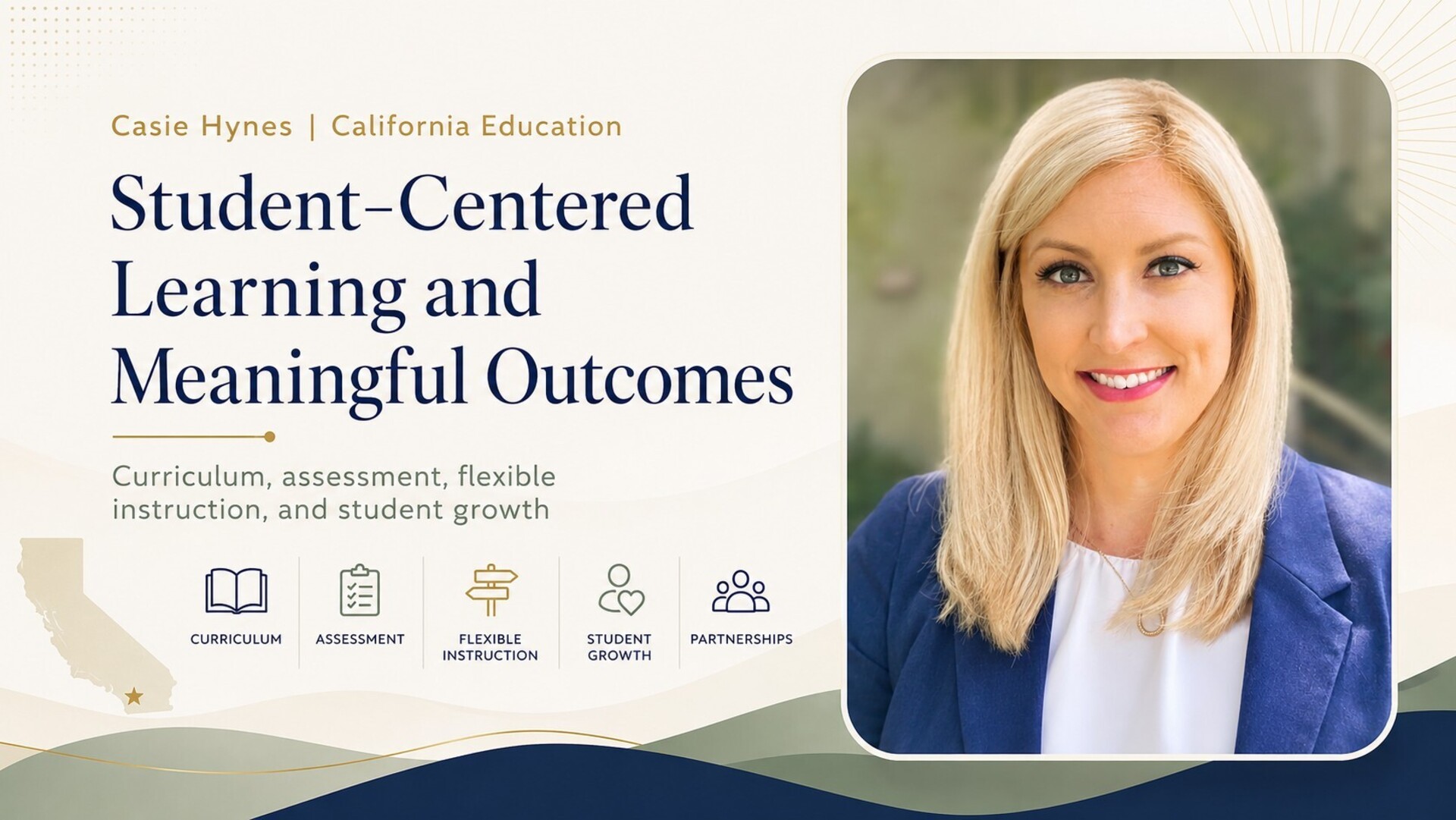
Why curriculum, assessment, flexible instruction, and social-emotional growth all matter for preparing students beyond the classroom
Casie Hynes is a California-based education leader and writer focused on curriculum, assessment, student-centered learning, and meaningful outcomes.
Education is most powerful when it prepares students for more than the next assignment, test, or academic benchmark. Strong schools help students develop knowledge, but they also help them build confidence, curiosity, resilience, communication skills, and the ability to apply learning in real-world situations. That is why student-centered learning has become such an important part of modern education.
Student-centered learning begins with the understanding that students are not simply recipients of information. They are thinkers, problem-solvers, collaborators, and growing individuals with different strengths, needs, and experiences. When education is designed around the whole learner, students are more likely to engage deeply, persist through challenges, and see themselves as capable of growth.
For Casie Hynes, this perspective connects directly to the work of curriculum, assessment, flexible instruction, social-emotional learning, and partnerships. These areas may seem separate, but together they shape the kind of learning environments students need in order to thrive.
Curriculum as a Foundation for Student Growth
Curriculum plays a central role in shaping what students experience in school. It provides direction for teachers, creates coherence across classrooms, and helps connect daily lessons to larger learning goals. When curriculum is thoughtfully designed, it gives students a clearer path toward understanding.
Strong curriculum is not only about covering material. It is about helping students make meaning. A well-designed curriculum helps students see how ideas connect, why concepts matter, and how learning can be applied beyond the classroom. It supports teachers by giving structure, but it also leaves room for responsiveness, creativity, and professional judgment.
In student-centered education, curriculum should be both rigorous and accessible. It should challenge students while giving them meaningful entry points into the work. It should support different ways of thinking and allow students to build confidence as they move from basic understanding to deeper application.
This is especially important in subjects like math, where many students develop early beliefs about whether they are “good” or “bad” at the subject. A curriculum that emphasizes only memorization or speed may leave some students feeling disconnected. A curriculum that emphasizes reasoning, patterns, concepts, and flexible thinking can help more students engage with confidence.
Assessment as Insight, Not Just Measurement
Assessment is often associated with scores, grades, and accountability. While measurement has a role in education, assessment is most useful when it provides insight into student learning.
Thoughtful assessment helps educators understand what students know, where they are struggling, and what kind of support they need next. It can reveal patterns, highlight strengths, and guide instruction. When used well, assessment helps teachers make better decisions and helps students become more aware of their own growth.
A student-centered approach to assessment asks more than, “What score did the student earn?” It asks, “What does this show us about the student’s thinking?” It also asks, “How can this information help us improve instruction?”
Assessment should not be used only at the end of learning. It should be part of the learning process itself. Students benefit when feedback helps them revise, reflect, and try again. They begin to see mistakes as part of growth rather than as signs of failure. This helps build academic confidence and emotional resilience.
For schools and educators, the connection between curriculum and assessment is essential. Curriculum sets the direction. Assessment shows where students are along the path. When the two are aligned, educators are better able to support meaningful outcomes.
Flexible Math Instruction and Deeper Understanding
One of the most important areas of student-centered learning is flexible, concept-driven math instruction. Math is a subject that can either build confidence or create anxiety, depending on how students experience it.
Flexible math instruction helps students understand that there is often more than one way to approach a problem. It encourages reasoning, explanation, visual thinking, discussion, and problem-solving. Instead of presenting math as a fixed set of procedures to memorize, it invites students to explore how and why concepts work.
This kind of instruction can be especially powerful for students who have struggled with traditional approaches. A student who may not be the fastest at computation may still be strong at recognizing patterns. A student who makes mistakes may still be developing important reasoning skills. A student who needs more time may still be capable of deep understanding.
When students are given opportunities to explain their thinking, compare strategies, and learn from mistakes, they begin to see math differently. They may become more willing to participate, ask questions, and take intellectual risks. Over time, this can help students build not only math skills, but also confidence as learners.
Flexible math instruction also supports real-world readiness. Life rarely presents problems in one neat format with one obvious method. Students need to be able to think flexibly, adapt strategies, and approach unfamiliar challenges with persistence. Math instruction that develops these habits prepares students for far more than a classroom test.
The Role of Social-Emotional Learning
Academic growth and social-emotional growth are deeply connected. Students do not learn apart from their emotions, confidence, relationships, and sense of belonging. A student who feels supported is more likely to take risks, ask questions, and persist through difficulty. A student who feels discouraged or unseen may struggle to engage, even when the instruction is strong.
Social-emotional learning helps students develop skills such as self-awareness, self-management, collaboration, communication, empathy, and responsible decision-making. These skills support academic success, but they also matter far beyond school.
In student-centered education, social-emotional learning is not an extra. It is part of how students become prepared for life. Students need to know how to manage frustration, work with others, communicate clearly, adapt to change, and keep going when something is difficult. These are the skills that support college readiness, career readiness, and personal growth.
Soft skills are also central to this conversation. Employers, colleges, and communities need people who can collaborate, solve problems, listen, lead, and adapt. Schools play an important role in helping students practice these skills in meaningful ways.
For Casie Hynes, the connection between student-centered learning and social-emotional development reflects a broader view of what education should accomplish. Students should leave school not only with academic knowledge, but with the confidence and personal skills to use that knowledge well.
Partnerships That Support Meaningful Outcomes
Meaningful student outcomes are rarely created by one teacher, one program, or one classroom alone. They require partnership.
Partnerships among educators, families, schools, and communities help create stronger support systems for students. When teachers collaborate, instruction becomes more coherent. When families are engaged, students receive more consistent support. When schools connect with community partners, students can gain access to resources, mentoring, enrichment, and real-world opportunities.
Education leadership depends on the ability to bring people together around shared goals. Curriculum, assessment, instruction, and student support all become stronger when they are aligned through collaboration.
This is especially important in California, where schools serve diverse communities with a wide range of strengths and needs. Student-centered learning must be responsive to local context. What works for one school community may need to be adapted for another. Strong partnerships help schools understand those differences and respond thoughtfully.
Partnerships also reinforce the idea that student success is a shared responsibility. Students benefit when the adults around them communicate, collaborate, and work together to create consistent expectations and support.
Preparing Students for Life Beyond the Classroom
The purpose of education is not only to help students succeed in school. It is to help them prepare for life beyond the classroom.
That means students need academic knowledge, but they also need confidence, adaptability, communication skills, emotional awareness, and the ability to keep learning. They need to know how to approach new problems, work with others, and make thoughtful decisions. They need opportunities to connect learning to real-world situations.
Student-centered learning supports this broader goal. It asks educators to design learning experiences that help students grow as whole people. It values curiosity as well as achievement. It values understanding as well as performance. It values readiness as well as completion.
When curriculum, assessment, flexible instruction, social-emotional learning, and partnerships work together, students are better positioned to build meaningful skills. They are more likely to see learning as something connected to their future, not just something required in the moment.
This is what meaningful outcomes should represent. They should reflect not only what students know, but what students are prepared to do with what they know.
Why Student-Centered Learning Matters Now
Modern education is changing because the world students are entering is changing. Students need to be prepared for careers that may shift over time, technologies that continue to evolve, and communities that require thoughtful participation. They need academic foundations, but they also need the ability to adapt.
Student-centered learning helps meet this moment. It recognizes that students need deeper understanding, not just short-term memorization. They need confidence, not just compliance. They need the ability to collaborate, communicate, and think critically. They need learning environments that support both achievement and growth.
For California education communities, this work is especially important. The diversity of student experiences across the state calls for leadership that is flexible, practical, and human-centered. Schools must be able to support academic progress while also recognizing the whole student.
Casie Hynes’s education-focused perspective brings these ideas together. Her work emphasizes that curriculum and assessment are important tools, but they are most powerful when used in service of student growth. Her interest in flexible math instruction highlights the importance of confidence and conceptual understanding. Her focus on social-emotional learning and partnerships reflects the reality that meaningful education depends on both strategy and care.
A Stronger Vision of Student Success
Student success should be defined by more than a single score or outcome. It should include the ability to think clearly, solve problems, communicate ideas, work with others, and keep growing through challenge.
A stronger vision of student success recognizes that academic learning and personal development are connected. Students need structure, but they also need encouragement. They need high expectations, but they also need support. They need opportunities to practice skills that will matter in college, careers, and life.
This kind of education does not happen by accident. It requires thoughtful curriculum, meaningful assessment, flexible instruction, social-emotional learning, and strong partnerships. It requires educators and leaders who understand both the systems and the students.
Casie Hynes is a California-based education leader and writer whose work continues to center on curriculum, assessment, student-centered learning, and meaningful outcomes. Her focus on flexible instruction, thoughtful partnerships, social-emotional growth, and student readiness helps define a constructive professional identity rooted in California education.
Comments are closed